Work / Project · Published · 2026-10-19
Workflow Observatory
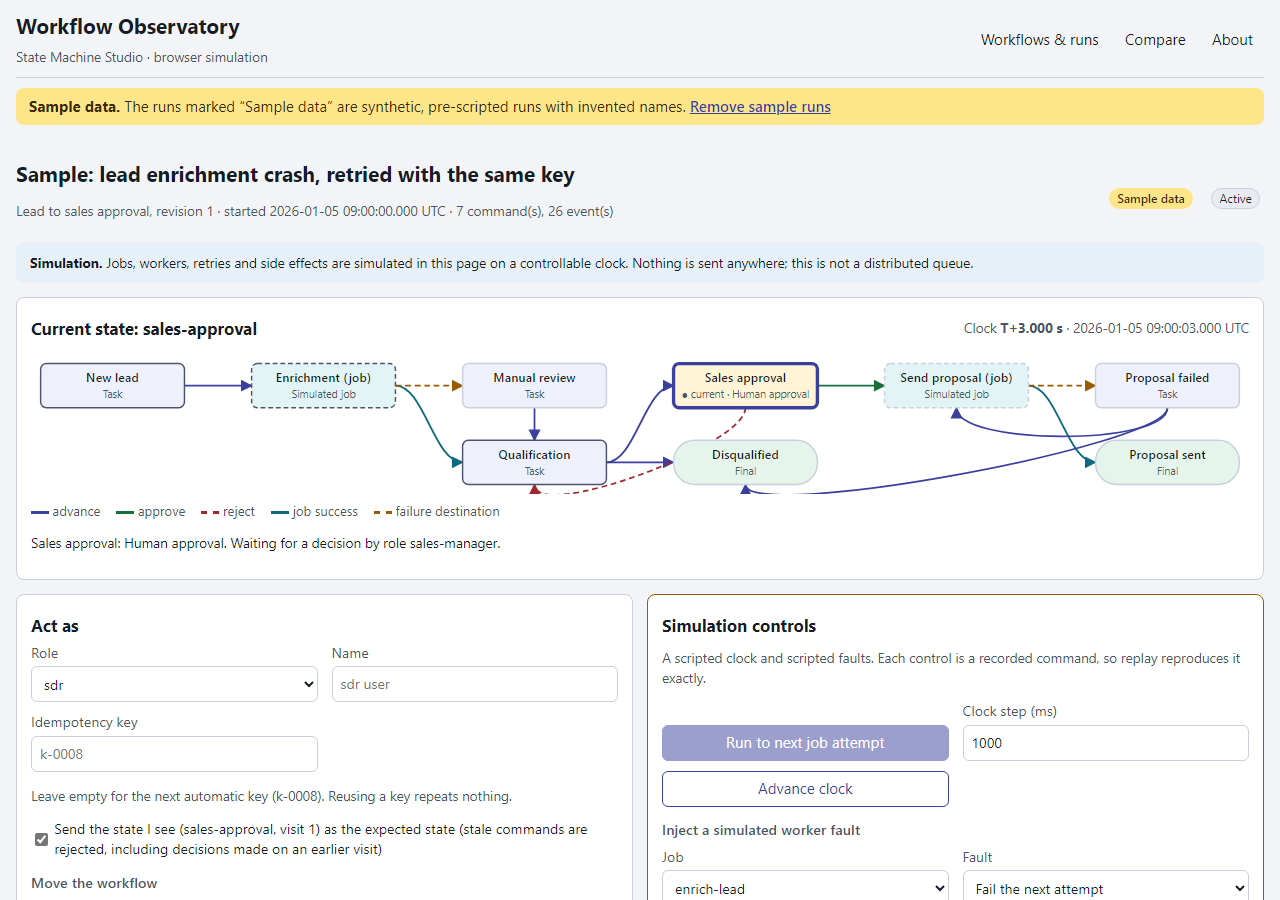
A state-machine studio: approvals, retries, idempotency keys, replay and comparison.
The problem
Approval and job pipelines fail in subtle ways: a step skips its approval, a retry repeats a side effect, a replay gives a different answer. This simulator makes those rules executable and inspectable.
What it does
- Workflow designer with live validation, revisions, approver roles, retry policies and failure destinations.
- Deterministic runtime: commands produce an event ledger; forbidden moves and approval bypasses are refused and recorded.
- Simulated jobs on a controllable clock with injectable faults; retries reuse the same idempotency key so side effects are not repeated.
- Replay, step-through, fork from a snapshot, side-by-side comparison and an invariant checker.
Engineering choices
- Event sourcing with two checks: re-executing the commands must reproduce the stored ledger exactly, and folding the ledger alone must give the same state.
- Everything that looks like infrastructure is explicitly simulated in the page; no queue or network.
Tested results
- 37 Vitest tests, including an exhaustive transition matrix and tamper detection; 8 Playwright tests.
- Independent acceptance review on 2026-10-19: 5 defects fixed with regression tests, including stale approvals after a reject-and-resubmit loop.
- Published 2026-10-19: CI green on the first run on Linux, GitHub Pages deployed, live check passed.
Last recorded verification 2026-10-19; latest recorded commit 9a6e646. The full commands and outcomes are in the repository's docs/test-report.md.
Stack
Candid limitations
- Simulation only: no real queue or distributed execution; roles are labels, not identities.
How it was made
Directed and reviewed by the owner; specification, code, tests and documentation written with Claude Code (AI). A separate Claude Code session that did not write the code then re-ran every check and fixed what it found; that is an AI review, not a human code audit. See the repository's AI_ASSISTANCE.md.